The Montana Success Story- Part Two

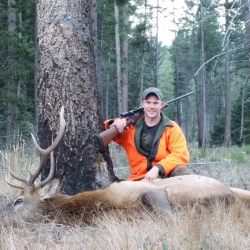
Bearman with a nice Montana bull on a do it yourself public land hunt
                          Bearman with a nice Montana bull on a do it yourself public land hunt

Yesterday I posted the first part of the Montana Success Story where we read about “Bearmans” first mulie harvest. The story only gets better! Please enjoy “Bearmans” recount of this awesome Elk hunt.

Elk season is a mythical window of time that calls to me all year.  From the day the season ends until the day it opens again I am constantly hiking, scouting, and dreaming of my adventures for the season to come.  This season in particular has been a roller coaster ride to say the least, and not just the kid’s roller coaster, but the really high go upside down kind of thing.  September bow season is my favorite time of year without a doubt.  The weather is perfect, scenery is fantastic, and the bulls are singing.  As far as I am concerned there are few things more pure and exciting than a bull elk screaming at daybreak on a calm fall morning.  Fortunately, I got into that familiar scenario multiple times in different locations throughout the season.  Not only did I hear elk, but I had some close calls; really close; head to head at 3 yards close.  Talk about an exhilarating experience.  Then there was the lowest of lows where an animal was wounded and not recovered. Even after all possible efforts have been taken to ensure that the animal is not immediately dead; the possibility always exists that he will die eventually.  Anyone who has hunted long enough knows this awful feeling and can just hope that the animal heals from a non-lethal shot.  Needless to say, bow season ended with mixed emotions, some great memories, and lessons learned. 

A week between seasons and it was rifle time.  After five weekends in the bow hunting woods with no meat to show for it, I was ready.  My rifle was dialed in, shooting a clover leaf at 100 yards and four inch group at 300 yards.  Opening day I returned to my favorite bow hunting area and saw a few elk but from over a mile away and no way to get in on them in time.  The following day I put my rifle to the test on my first mule deer buck which performed flawlessly.  Very satisfied to have a buck tag filled, I felt less stress to pursue a bull until the snow started sticking.  With one week between daylight savings time,  coaching Junior High football after teaching Shop at the high school, I decided to take some friends out hunting and try to have them fill their deer tags.  The plan was to put them on what I thought to be the better spots and I would circle below and try to push some deer in their direction.  So with no real intention on hunting too seriously I set off to break in my new boots and exercise my rifle.  A few miles in I jumped some does that ran back uphill towards my hunting companions.  At that time I stopped and contemplated the strange gut feeling to change my course that I have felt on many successful hunts before.  Without hesitation I turned off the trail and slowly wandered down through an old logged out area of timber with some old ponderosa pine trees mixed with new fir tree undergrowth standing about ten feet tall.  I still hunted down through the area until I broke a stick under my boots when I stopped. Looking out about 150 yards on the edge of the cut I spotted something tan behind a small fir tree.  Bringing up my scope I could see the definite outline of an elk butt and hind leg frozen in place listening to the stick I had just broken.  The elk had not yet seen or smelled me so I cow called a few times to make me seem like one of the herd.  Sure enough the elk turned his head showing me that he was in fact a bull.  A few minutes later he started to walk again.  Now I could see that he was in fact a legal bull with at least a four inch brow tine but had no shot opportunities through the timber.  The first available shooting lane was nearly 100 yards in front of were the elk was headed.  If he stepped out there it would be roughly 225 yards and I would be ready.  Three cows seemed to appear out of nowhere right in that spot and looked very uneasy.  The wind began to hit my neck and the cows must have got a little whiff of me and turned back into the timer out of sight. Meanwhile the bull was approaching the opening where I would hopefully be able to make a shot when he stopped to look at his cows.  I thought, “Oh no he’s going to follow those cows and be gone for good.” He only needed to take two more steps but he looked like he wanted to change his mind so I cow called one more time to get his attention.  It did the trick.  I was sitting down with rifle rested on my knee. He looked back uphill out of curiosity and when he walked two more steps to get a better look I sent a bullet down range.  Now twenty cows joined him and were running through the clearing.  I racked a round, found him in the scope, fired and watched him drop.  I could still see him alive with his head up so I quickly finished him off with a neck shot.  My after work tromp through the woods had just ended with a magnificent creature on the ground. 

Well it didn’t end there.  Anyone who has ever killed and elk knows that the work really starts when the shooting stops.  I got it gutted out as the sun finally sank behind the mountains and headed back to the truck to meet the other two and tell them the story.  There’s a song that says, “…you find out who your friends are”, but I think Tracy Lawrence left out a verse about finding a pack crew when it’s miles from nowhere and dark out.  Being the lucky guy I am it only took an hour and there were four of us with bikes and pack frames ready to roll down an old gated road.  The date was October 27th with clear skies, temps in the low 30s, and a big full moon.  For me, the memories of the pack out have been comparable to that of some of my best hunts.  Four guys brought together by the common love of hunting headed through the woods with mountain bikes and only the light of the moon casting shadows through the trees.  The whole time my dog Angel running beside us as part of the team. This if for sure a memory that I will not soon forget. Tagged out and time to make summer sausage!”

Awesome story Bearman, thank you for sharing. As I said before, this guy is a great example of how to work hard, scout often and put your time in the woods to harvest some quality animals. Thank you for reading and be sure to check out our Facebook and Instagram pages for great pictures.

-Michael

The Montana Success Story- Part One

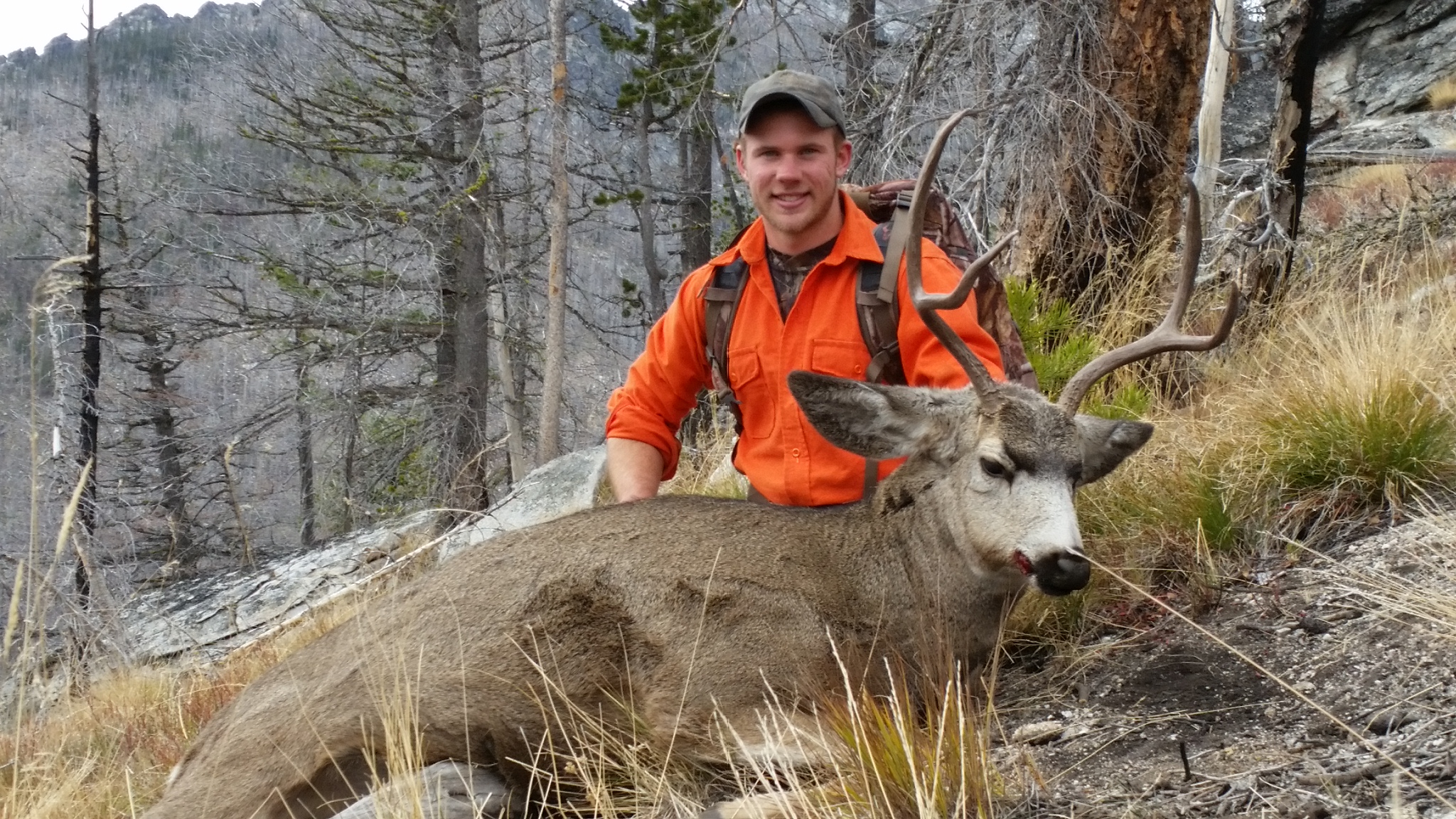
Bearman with his first Montana Mule Deer
                                                             Bearman with his first Montana Mule Deer

I‘ve learned a lot about hunting and persistence from my buddy “bearman” and since his move to Montana, he has developed to become one of the most successful hunters I know. The guy puts in serious time and loves to walk miles in search of untouched hunting grounds. This past Sunday to Tuesday was his greatest hunting accomplishments to date. Please enjoy Bearman’s awesome recount of his first Mule deer.

Bearman Close up Mulie
Long pack home!

It was a late start to the morning following a strenuous death march the previous day in search of elk.  With high hopes I traveled from my home in Darby down the Bitterroot Valley to meet up with long time hunting buddy Mike Kaplan to cover some new country.  For me, today’s mission was to find a mule deer buck in the high country for the area which I had drawn a permit for.  Deer numbers in this area are low, so to see any is a success in itself, but for us the thrill of new adventures keeps us hiking on.  At mid-morning on an overcast 55 degree calm day we found ourselves hiking higher and higher through steep rock, burn, and timber.  Several miles and several hours into our hunt we came over a ridge to find nine mule deer does feeding across the opposite hillside about 200 yards out; but no bucks to be found.  After watching them for a while, we let them feed over the next ridge before making our next move.  A short trek later we were on top of some radical rock formations overlooking the same group of deer in the next draw over.  With the afternoon slowly ticking away, and near to our estimated turn around location, Mike decided it was time to head back to the truck.  At that point my genetically adventurous spirit took over and told me to look over just one more ridge.  Many times this voice leads me to that ridge or hill, and then another, and another, and another, with an end result of nothing but an exhausted Max; but not today.  Today Mike split back towards the truck as I went one more ridge over.  As I crept out of a heavily timbered gully into a decade old burn and there caught the glimpse of two mule deer butts gently easing over the horizon line 300 yards in front of me.  With anticipation high, my legs and lungs carried me quickly through deadfall and standing tree skeletons uphill in the direction that the deer were moving.  Breathing heavy and soaked with sweat I approached a giant boulder at the edge of a sharp drop off.  Many hours in the field had me prepared to be ready at an instance upon reaching the edge, so with my Remington  7mm-.08 at the ready and pack unstrapped, I peered over the edge of the large boulder.  Immediately I could see ears and eyes focused on me at me 80 yards straight ahead, along with a clearly visible antler! I had one shooting lane about four feet wide with his head, neck, and most of his front shoulder visible.  Although I prefer to sneak a bullet in behind the shoulder as to not waste valuable meat, at this moment I knew I had no other options.  Lying down with the rifle now steadied on a large rock, my crosshairs settled on the deer’s shoulder.  A split second later my ears were ringing from the shot, the empty casing was rolling down through the rocks, and the buck I had just shot at turned into two muley bucks bounding off through the burn and headed deeper into a hell hole of a canyon below. 

The legendNot knowing which buck I had shot at, or being presented another shot at the deer, I watch one bound over the hill on the horizon as the other bailed off left and crashed out of sight.  Heart pounding I headed to where the deer were standing when I took the shot.  No blood, no hair, and an uneasy feeling setting in, I began to walk downhill where I had heard the one deer crash through the deadfall.  Within moments, my worries were turned to feelings of joy when I saw the fur on his large body piled up against a tree.  My first mule deer buck had only run 40 yards with a well-placed 139 grain Hornady to the boiler maker.  I quickly used my one bar of cell service to call Mike and utilize his concrete crew strength to help me with the pack out.  A few hours later we were loading the buck in the truck and soaking up the memories from anther great adventure.  It is not the kill itself but the hard work, beautiful country, adventure, time with old friends, lean meat, and memories that last forever that keep true hunters like us headed to the mountains year after year.”

-Bearman

Thanks for your awesome recount of this great hunt Bearman. Folks, be sure to check out Green Lake Chronicles tomorrow for part of of the Montana Success Story! Thanks for reading and be sure to check out our Facebook and Instagram pages for great pictures.

-Michael

Let’s Talk Broadheads

Bearman-Buck
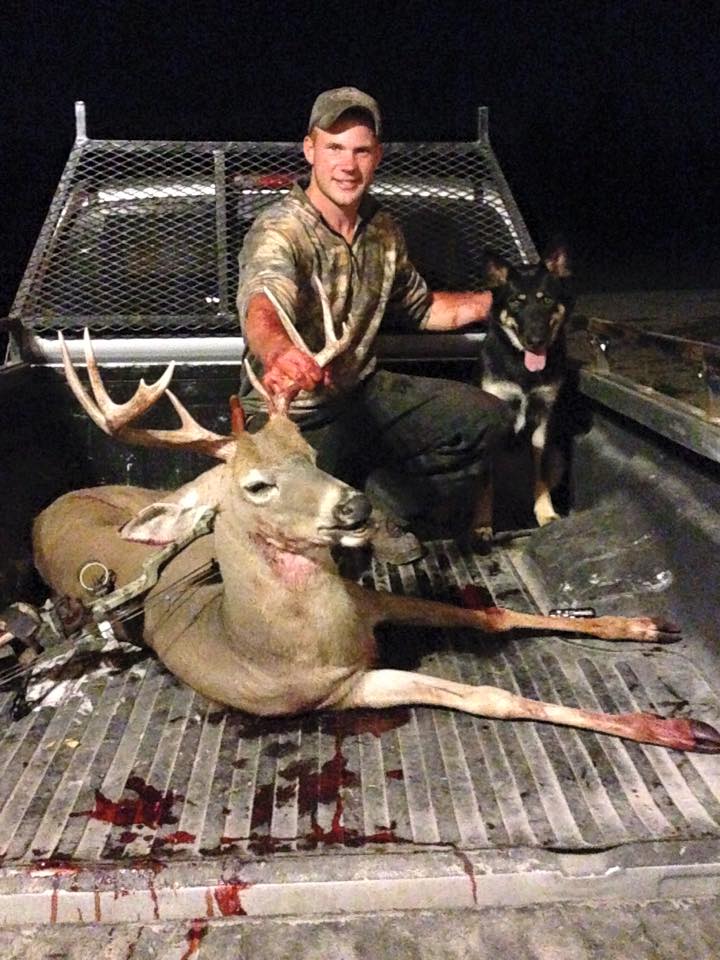
Chronicles Pro-Staffer, Bearman, with a nice Montana buck. #slicktrickbroadheads

When I started bow hunting (little over 14 years ago) I didn’t have a clue about the “science” and tuning needed to make sure my broadheads/arrows flew true. I was shooting my dad’s old Bear Archery Whitetail II bow, which weighed a ton and had 50% let off and was using an assortment of old broadheads I found in his gear box. Remeber the funky head called, Pucketts Elk Head Bloodtrailer? I shot this for a year until I finally learned how to tune my fixed blades, then made the switch to Muzzy. I shot my first buck with a bow when I was 15 and the old school Muzzy three blade zipped right through the lungs. Broadheads have come a LONG way since then and folks have many different options to choose from.

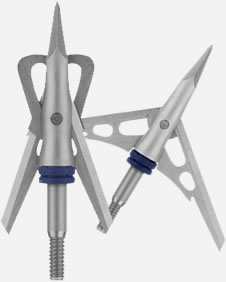
Image courtesy of google.com/images

My biggest thing, is to choose a head that will not require a ton of tuning. I want to slap it on the arrow and go. I switched over to mechanical heads 10 years ago and have continued success getting deep penetrations and clean pass through. The original Rage 100g head is nasty, boasting a 2” cutting diameter and cut on impact head. Since Rage energized the market with this simple, reverse slip cam technology, many other manufacturers have stepped up their game. There are a million different calculated and fluffy reviews out there on brands you should shoot, but when choosing a  head, I break it down into three simple categories and pick the best one regardless of manufacturer.

Toughness- Whitetails are a rugged animal and if you do not get a double lung or heart shot pass through, you want to choose a head that has enough kinetic energy and durability to bust through bone. Most of the deer I’ve killed have been quartering shots, where I try and zip the arrow through the rib cage into the front shoulder area. A cut on impact, durable head will get you more penetration and hopefully pass through any bones. Broadheads are expensive too! I want to be able to use the same head after I shoot a deer (with changing blades of course) and cheap/fancy mechanicals are  usually one shot and done.

Reliability- When you are drawing back on a nice deer,  you want to make sure the arrow is going to fly straight. Fundamentals right? Many people who write poor reviews about fixed blade broads, do not take the time to tune accordingly or match their arrows per grain tip. I love fixed blade and have played around with some through the years, but I always make sure I shoot them before going into the woods. Fixed blades tend to be more sturdy, rugged, have deeper penetration and cut on impact. The drawback (other than tuning) is they lack in cutting diameter. Compare those to a mechanical, which predominately have a much larger cutting surface and no field tuning. Their drawback is the potential for failure with the mechanisms. I want a head that I know will work 100% of the time.

Penetration- Traditional fixed blades are known to cause more penetration than mechanical. There is no loss of kinetic energy upon try as with most mechanical broads. Some broadhead manufacturers have tried to fix this problem, such as Rage and Grim Reaper, with expansion on little effort. Bottom line is that you are going to lose some penetration using a mechanical, so you have to figure out whats more important to you. I prefer a head that will penetrate well and open up a wide cut path. Bigger cutting diameter heads will have a tougher time blasting through bones, but will leave a devastating hole.

There are a ton of broadheads out there, but the most important thing is that you choose one that fits your needs and one you can rely on. As I mentioned above, I like a head that cuts on impact, opens up a nasty cut path and penetrates well. Here are my no BS recommendations:

slick-trick-broadhead picFixed Blade- Slicktrick Standard 100g. I have seen many animals taken with these heads and they always seem to fly true. They have a solid steel ferrule with a cut on impact and bone crushing head along with four extremely sharp 1” blades. This head will create a clean and deep whole without giving up flight consistency. The blades lock in tight and stay in position. Buy these anywhere for about 38 bucks.

hypodermic_deep6Mechanical- Rage 100g Hyperdermic. I don’t need to say much about these guys. They have a kick ass head. Flies true as a field point and creates a devastating 2” cutting diameter. The body/head is different from the older Rage and comes with a solid one piece steel ferrule. This is one of the best penetrating mechanical broadheads on the market and they open up wound channels like you wouldn’t believe. Buy these anywhere for about 45 bucks.

Thanks for reading, I hope you enjoyed this post. If you have any questions, please contact me at greenlakechronicles@gmail.com. Be sure to check out our Facebook and Instagram pages for great pictures.

-Michael
Deer Hunting Forecast-Northeast

Rut Buck Shotgun
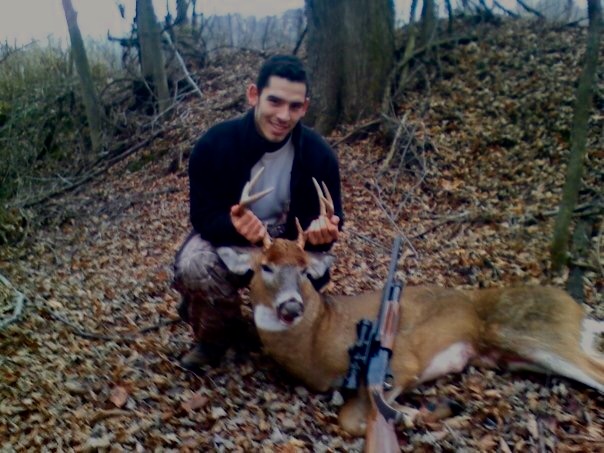
Nice 8pt shot during prime “chase” phase during regular season in Cayuga County, NY

As you have seen from my past articles, I primarily deer hunt in New York where the annual deer harvest is one of the highest in the country. Most of the deer taken are from gun season (which can be like WWII from city hunters) but archery season is very quiet throughout the state. For this 2015 season, the experts are projecting the rut to kick off about a week earlier than last year.  This will bode well for archery hunters. Hunting whitetails during the rut, especially in the Northeast, is one of the best times to increase your chances at taking a nice buck. Clearly a no brainer, but be prepared for bucks to start chasing earlier this hunting season, so plan to adjust your tactics accordingly.

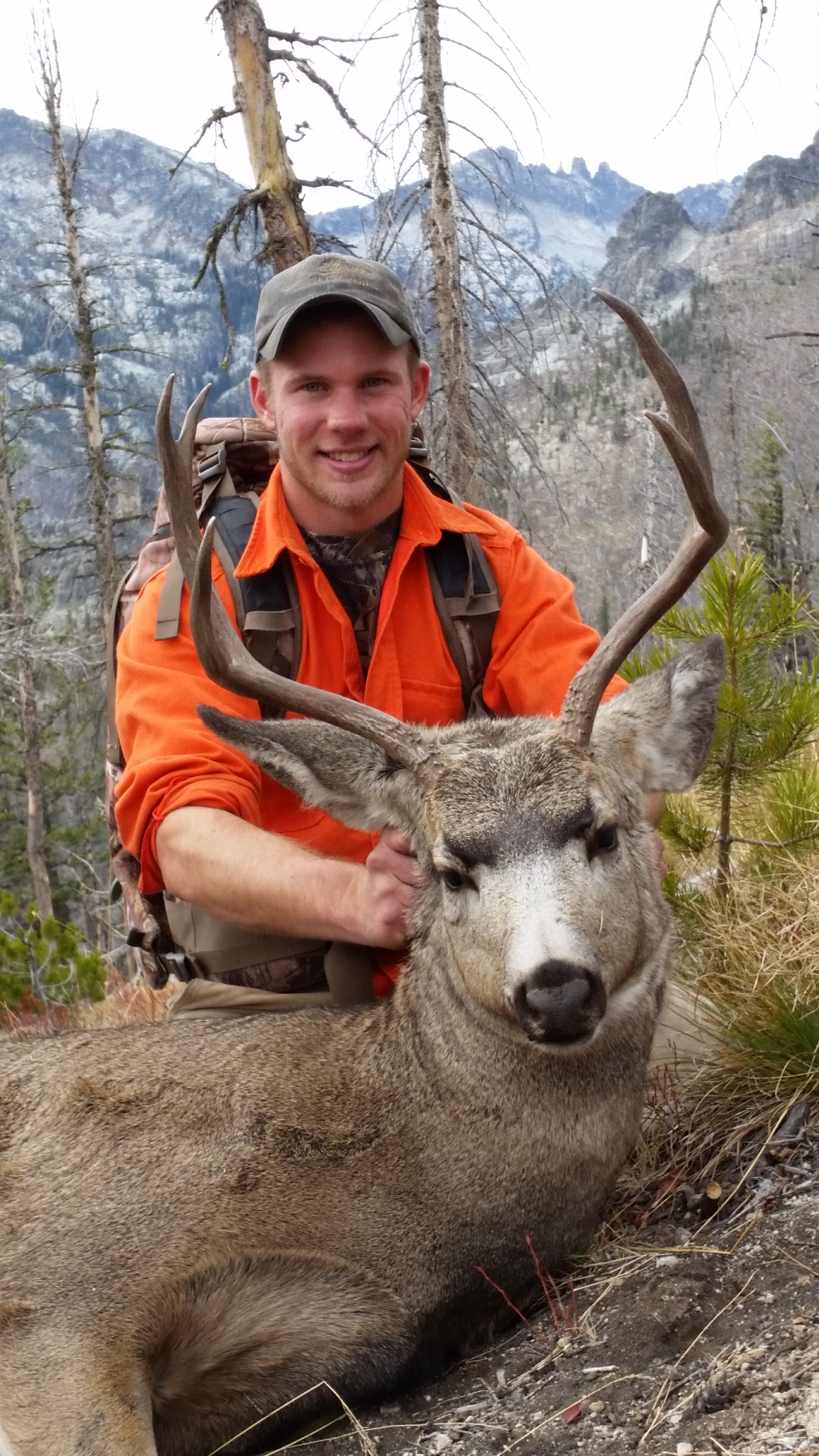
Archery buck taken during the "seeking" phase of the rut
Archery buck taken during the “seeking” phase of the rut

There are different theories as to when bucks begin their rut and the most popular one is to follow the moon phase. This year, the rutting moon falls on October 27th. The rutting moon is the second full moon after the Autumnal equinox. I’ve read a few articles that say this will trigger bucks to begin their early “seeking” phase of the rut. Some does will begin an early estrus cycle during this time. Be prepared to change your tactics from hunting predominately over food areas to bedding transition zones or rub lines.

I haven’t killed the monster bucks like the Lakosky’s, but I have success every hunting season following fundamental tactics. In the early season I strictly choose to hunt near food sources or transition zones. During this time, I build a profile of my hunting grounds and lock down deer patterns. I rarely use any estrus in October, but occasionally put a scent wick out if the weather patterns become unseasonably cold. With my experience, temperature in Upstate NY is one the leading factors that affects rut activity. Deer will start moving around much more and not be locked into their nocturnal patterns. During the early stages of the rut, I spend a lot more time on post, typically taking a two hour break for lunch and sometimes changing my afternoon stand location. Putting time in the stand will get you a deer, but yes you can get lucky just sitting for the last hour of daylight! I’ve shot some nice deer during midday and highly recommend you sitting as long as you can during chase rut.

I hope you have success this hunting season! I will post more videos and articles once November comes around when I don’t have my hectic 9-5 schedule. Be sure to check out our Facebook and Instagram pages for great pictures. Thanks for reading.

-Michael

Gear Review: Wildgame Innovations Cloak Trail Camera

Wildgame Cloak

I made a big push this year to try out a few different trail cameras  to test out. Pending results I plan on buying a bunch of the best one in bulk for my properties in NY and our family’s outfitting business, Blue Walleye Outpost in Quebec, Canada. I already have a few of the older Wildgame Innovations models and have a neutral opinion on them. Trail cameras dramatically increase your chances on taking a nice animal and allow you to pattern appropriately. This year, I bought the new Wildgame Innovations Cloak, Wildgame innovations Razor 8x Lightsout and the Bushnell Trophy Cam 8mp. Earlier in the year, the Chronicles crew planted a few small food plots on one of our pieces of land in the Southern Tier of New York. I placed the Cloak camera on a small tree towards the top of an overgrown field, that overlooks our test plot.

Big boy cruising the top of the field

I was somewhat skeptical of this camera’s placement, but was hoping to get intel on bucks running the edge of the field and or deer coming into the plot. Only after a few weeks, the results were awesome. The photo on the right is of a nice 9pt cruising the top of the field near the food plot. We have him in many other pictures, typically at night and alone. The cloak also captured some turkeys, bunch of other smaller bucks and two wily coyotes. Here are my thoughts on this camera:

Functionality: 5/5 stars. The cloak is extremely easy to set up and is compact to fit in tight spots. It’s made of a durable plastic material that is waterproof.

Setup: 5/5 stars. I am a little old school and prefer to not waste time messing around with different settings and shooting modes. I like it simple, quick and reliable. The Cloak is really easy to use. Put in the correct date/time and your’e basically done. There are a few different options, but it does not get confusing like other, more complex cameras. Set, point and shoot.

Camera quality: 3.8/5 stars. The 4 megapixel lens is nothing to get to jacked up about, but the quality of the images are far better than $100-200 cameras that were available years ago. My dad always said that you get what you pay for and if you are expecting superior images, then you will be disappointed. The pictures are good and there will have no issues determining the size and quality of the animals that get captured.

Features: 4/5 stars. The cloak offers a fast one second trigger speed, 50-ft detection range, 18-LED infrared flash bulbs and up to 30 second capture video clips. If you want something fancy, then you will not fall in love with these features. As I mentioned above, they are perfect for me and other hunters who want a simple option.

Price: 4.5/5 stars. The cloak is not to expensive and competes with cameras above $100. They retail for about $69.99 and can be found at almost any outdoor shop. If you are looking to buy a handful of the same camera’s, the Cloak won’t break the bank and will give you a solid product.

Battery: 3.8/5 stars. Wildgame promotes this camera as one to take up to 10,000 pictures on a full battery. I don’t have 10,000 pictures yet, but I have changed the batteries once about 3.5 months after I put it up. This summer has been extremely hot and I know that can affect the power output, but be prepared to check camera often and change batteries accordingly.

Overall I rate this camera 4.38 stars.  I like it and plan on buying more. Super simple, easy to set up and the trigger speed captures some great pictures. It gets the job done for what I need. I would definitely recommenced this camera if you want to spend under 100 bucks and get something reliable. If you have any questions about this post, please contact me at greenlakechronicles@gmail.com. Be sure to check out our Facebook and Instagram pages for great pictures. Thanks for reading.

-Michael

Bachelors
Bachelors
Wildgame turkeys
Couple turkeys
Shooter in a few years

Do You Remember Your First Time?

I have had the privilege of being raised in a family that shares a passion for the outdoors. My father is one of the best deer hunters I have ever met and he raised me to respect firearms and value outdoor recreation. As I became more experienced, I wanted to share my passion with folks within my social circle. I chose to attend SUNY Oswego in North Central New York, because it was an excellent location for outdoor activities and the education wasn’t too bad either!  I met my best buddies up there and recruited them to join me in the woods or on the river. Many of them never really hunted before or cast out a line. Almost ten years later (since my freshman year) a few of my recruits are now avid outdoorsmen and continue to strengthen their skills afield.

Dave (left) and I with his first deer

One of the most special and memorable hunts I have ever been on was one that I was a spectator to my good buddy Dave taking his first deer. We were hunting the difficult Adirondack Mountain State Forests, where you may not see anything for years, but when you do it would most likely be a buck. It was late October/early November and the Chronicles Crew (with other affiliates) were on our annual “dack” hunting trip. This was always a fun time together, since many of us were coming from different parts of the country and got to reunite while hunting. The year before, I hunted with Dave on a mountain ridge that overlooked a nice gully pinch point. We planned on hunting the same spot the following year. Dave and I split up for the first few hours, hunting about 500 yards from each other and planned on meeting up somewhere in the middle to eat breakfast. Coincidentally, we hooked up on the exact ridge where we hunted the year before. At that time, we did not have GPS so it was ironic we found the exact same spot as the last year. We discussed our morning hunt and schemed for the remainder of the day. As we were choking down some cliff granola bars, Dave get’s quiet and tell me to “shut up, shut up.” I had my back turned from the downside of the hill, facing Dave. Out of the corner of his eye, he saw a deer walking parallel to us on a string to his Tinks Scent Bomb hanging in a tree about 50 yards down. I kept asking, “what do you see, what is it?” I was locked still, watching the whole thing happen from Dave’s perspective. Then he slowly raised his rifle (shaking profusely), takes a deep breath and BANG. Keep in mind, I never saw this deer and had to wait, for what felt like hours, to see what would happen. We both get up and look down hill to a 7pt laying dead.   SUCCESS! Dave had just taken his first whitetail ever and I was there to experience the whole thing. Dave was one of my original outdoor recruits from college and now was a proven deer hunter.

This hunt still remains in my top five best memories afield. The video above is Dave recalling the hunt. I posted it years ago on my former blog, so please disregard the URL at the end.

I would love to hear about your stories about the first animal you took in your hunting career. Please feel free to post a picture and a short summary on our Facebook  visitors page. Looking forward to reading about your first time!

Michael

Browns Campground-Altmar, NY

Browns Campground

This past weekend, the Chronicles crew ventured west to Pulaski, NY eager to get a fat Chinnok on the line on the Oswego and Salmon river. Fishing was tough, we only hooked up a few times and were not able to cross the deep parts of the Oswego river to our hot spot by the dam. The water levels were high and extremely dangerous. The salmon river was chalk full of people, but we were able to land a few fresh Chinook salmon.

The Green Lake Chronicles Crew has been making this annual trip since October 2010. We pitch our tents at Brown’s Campground located in Altmar, NY right off route 13. Browns campground is owned by Sonja Brown and operated by Pete and Monica Garner. Monica is Sonja’s daughter and has grown up watching thousands of fishermen/women enjoy the Salmon river bounty. We always arrive late, find a vacant tent site and set up shop. Even at 2AM, the campground is full of excited fishermen/women prepping their equipment for the morning outing. The scenery is amazing, located nearly on the Salmon river and the stars are as bright as LED light-bulbs. The owners are extremely welcoming and unbelievably gracious. They have a main office with a tackle shop, RV electric hook up, salmon cleaning station and bathhouse (showers and toilets included). Pricing is extremely reasonable, being dependent on length of stay, amount of people in your party and choice of camper unit or tent.  What differentiates this campground from it’s competitors, is the private access to the nostalgic salmon river and the hospitable staff. Hands down some of the best people I have ever met. Campers are able to walk a short distance from their tent/camper to the lush salmon fishing grounds with their private access point. Browns also offers a fish smoking service with immediate turnaround. Catch your fish one night, surrender it to the “fillet master,” and come back the next day within 24 hours to collect a tasty smoked salmon treat.

Northern zone archery kill

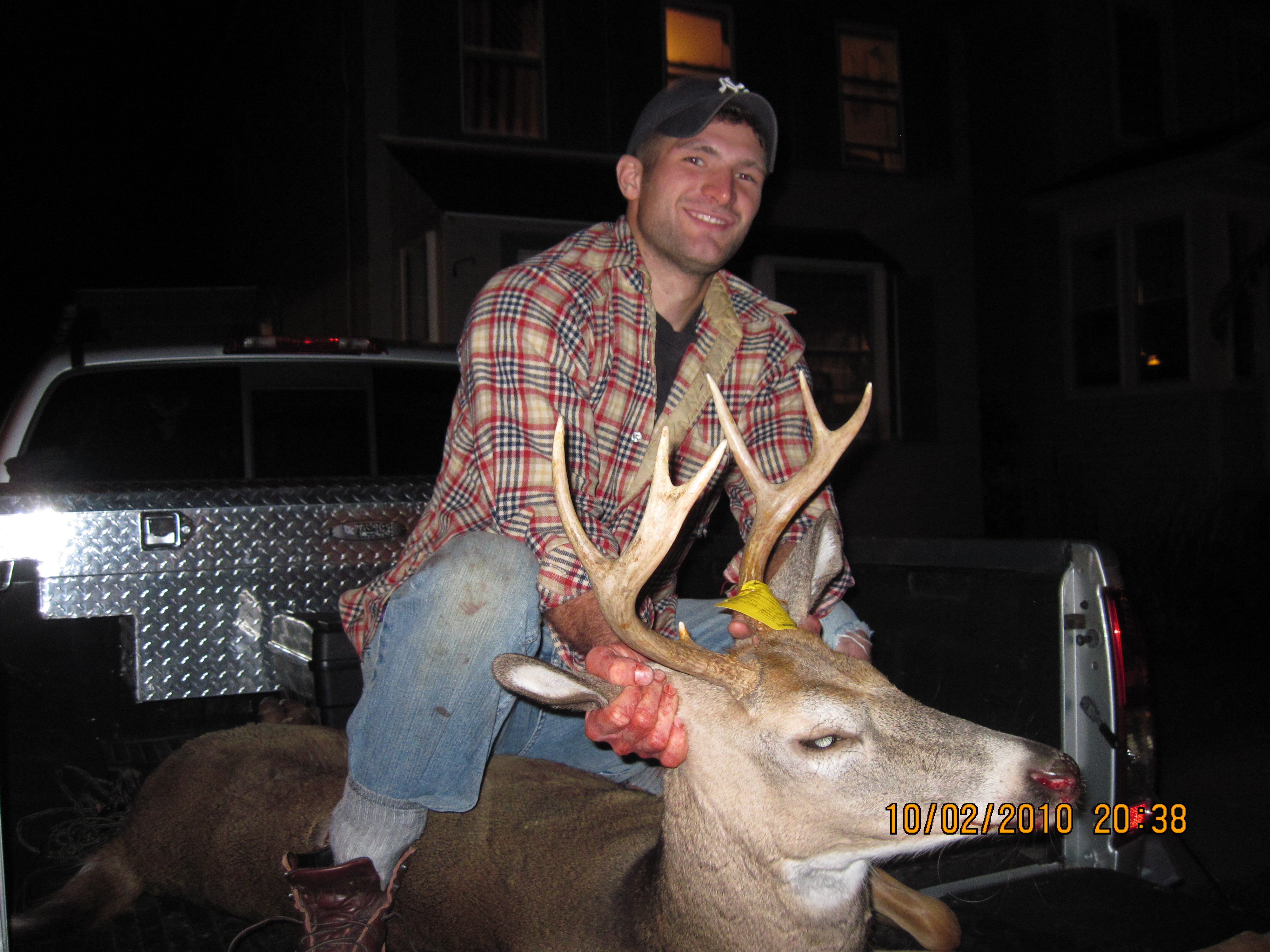
Not only is the fishing fantastic at Browns, but there is a slew of public hunting land available nearby to chase whitetails. One of the best trips to date was October 2010. We slammed the salmon in Oswego and on the salmon river access point at Browns Campground and I shot a nice 7pt buck with my Mathews. Cast and blast can be a fun weekend for those who are looking to break up their Salmon fishing itinerary.

I plan on making a trip to Browns every year and will eventually bring my future kids along for the adventure. Monica and Pete and great people and will give you a warm welcome every time. Many of their campers are regulars dating back 20+ years. If you plan on making a trip to Salmon country, I strongly urge you check out Browns. For booking information, please contact Monica at brownscampground12@yahoo.com. If you have any questions, please contact me at greenlakechronicles@gmail.com. Thanks for reading!

Michael
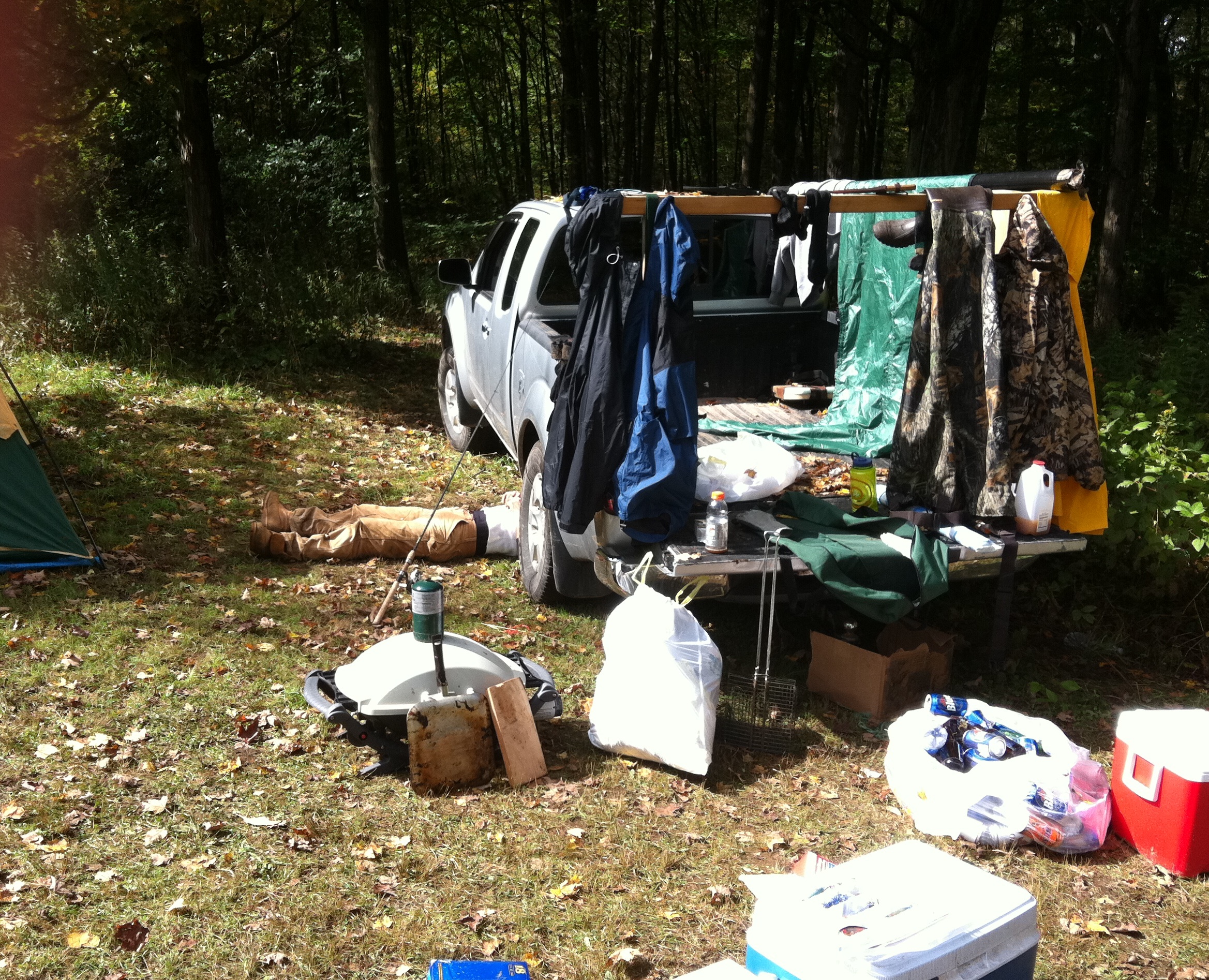
After a long day of salmon fishing, I relax in the shade under my truck

Salmon River Madness

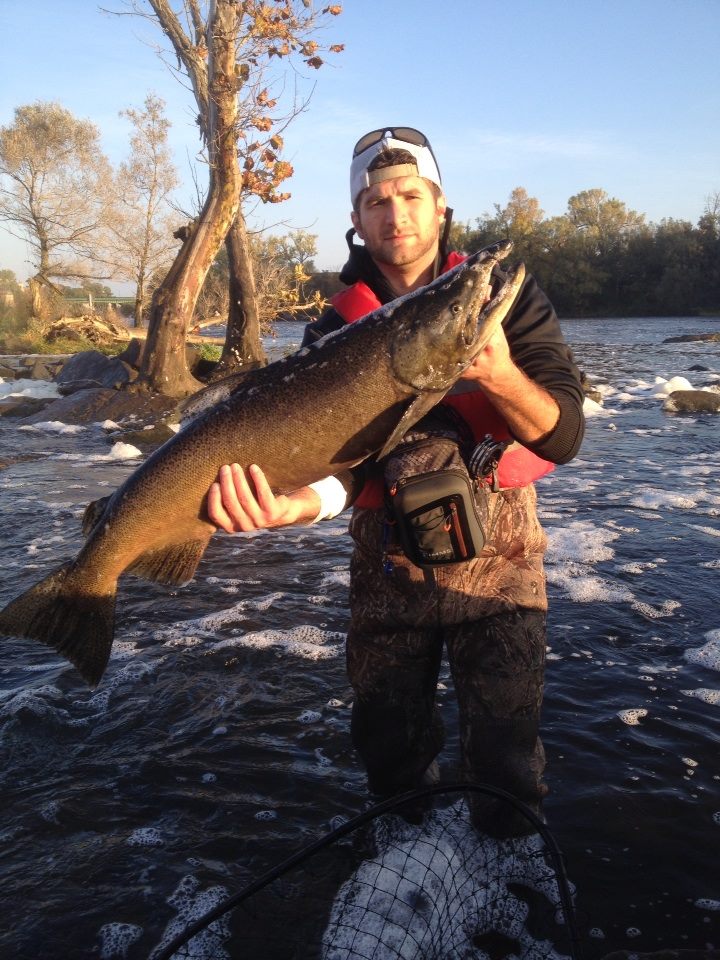
Chronicles crew with a nice keeper chinook
Some of the Chronicles crew with a nice keeper Chinook Salmon

It’s that time of the year again! This weekend, we Boston boys will be making our annual trip to Pulaski, NY to butt shoulders with other fisherman on the overcrowded Salmon and Oswego River. Sounds fantastic right? The stress of potentially not securing your spot and fighting with a massive local “Oswegonian” is well worth it when your line gets tight and the drag starts screaming! A few of us went to college at SUNY Oswego and started fishing for these freak fish over eight years ago. Now that we have “respectable” jobs and more responsibility, we look forward to this annual trip to escape  and continue our pursuits of these monster salmon and cold Labatt Blue.

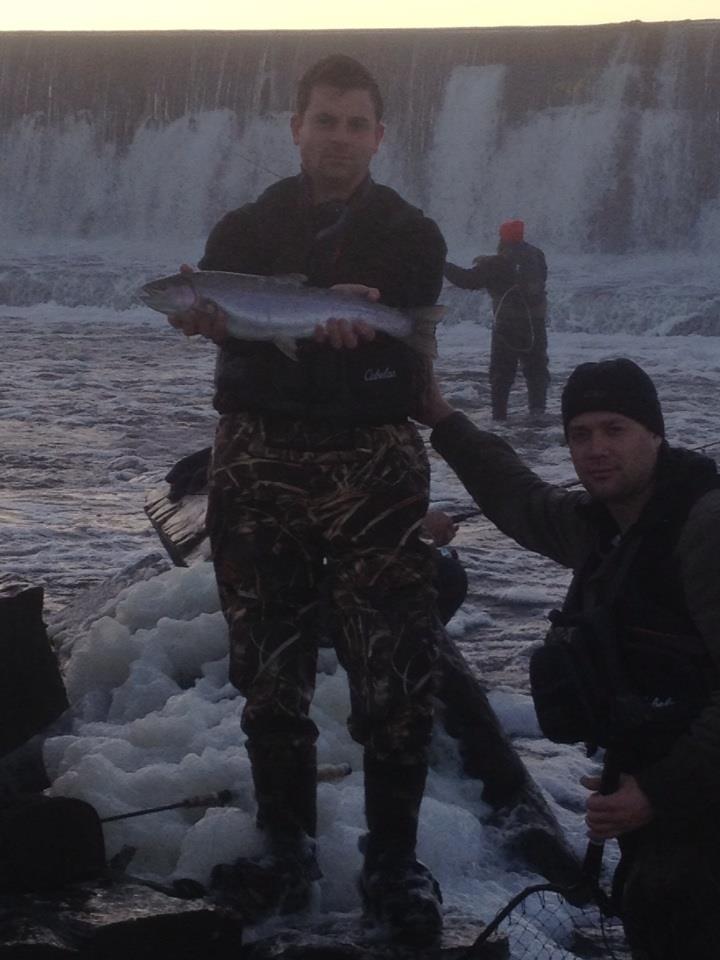
Early Steelie caught by Mr. Jones on blue egg sac
Early Steelie caught by Davey Jones on a blue egg sac

I am going to give you the most important piece of advice to help you land a salmon this fall.  Do not get too drunk the night before you fish. GET TO THE WATER VERY EARLY to secure a spot and do not leave until you are exhausted. The river will start filling up with fishermen between 6:45-7:15AM. If you safely get into position a solid hour before the others, there shouldn’t be an issue with crowds until 7:30AM. The rivers can get packed with people, but it is well worth it. The past few years, we have been having more success with hooking up and landing steelhead and bows. Salmon hook ups are frequent, but they run so hard and often come off the line.

I am not an expert at catching these things, but have had some good success following the factors listed below:

Water depth and flow – The higher the water level the better, the faster the water, the more oxygen, get the drift? There is a sweet spot with flow/depth. I like fishing the Oswego River when it’s between 4,500-6,000cfs. This river can be dangerous as hell if it get’s higher, but I have always had success during this flow.

Preliminary salmon runs – Location is key! Salmon can randomly begin their cycle depending on environmental factors such as water depth, flow and temperature. Typically the best runs start Columbus day weekend and end early November, but you never know when a major push will happen. Stay updated on local blogs and fishing reports and plan to have flexibility in setting the date for your trip.

Weather – The salmon run can greatly be affected by the weather patterns, a drop in temperature can result in a preliminary or unexpected run, as listed above. Cold nights and cooler daytime temperatures will help move the fish up river. You can never really predict the weather, but try and fish when it is getting a little colder.

“Stay Sensitive”- If you plan on using a spinning outfit, make sure you have the right line to feel your sinker kiss the bottom of the river while your leader sways into a fishes mouth. This ticking is important, because your hook (which should be on a leader, three feet behind weight) will hopefully pass through lines of fish. Salmon will rarely eat or go after your hook, so “lining” them is the best way to get success. Having minimal stretch line with narrow diameter will help you feel the tick and have more hook sets.

If you see someone attempting to snag the fish, rat their ass out to the DEC. Snagging is horrible for the fish and not real fishing. Thanks for reading and if you have any questions, please contact me at greenlakechronicles@gmail.com. Be sure to check out our Facebook and Instagram pages.

Michael

Salmon River map

Fat king caught on a homemade estaz fly
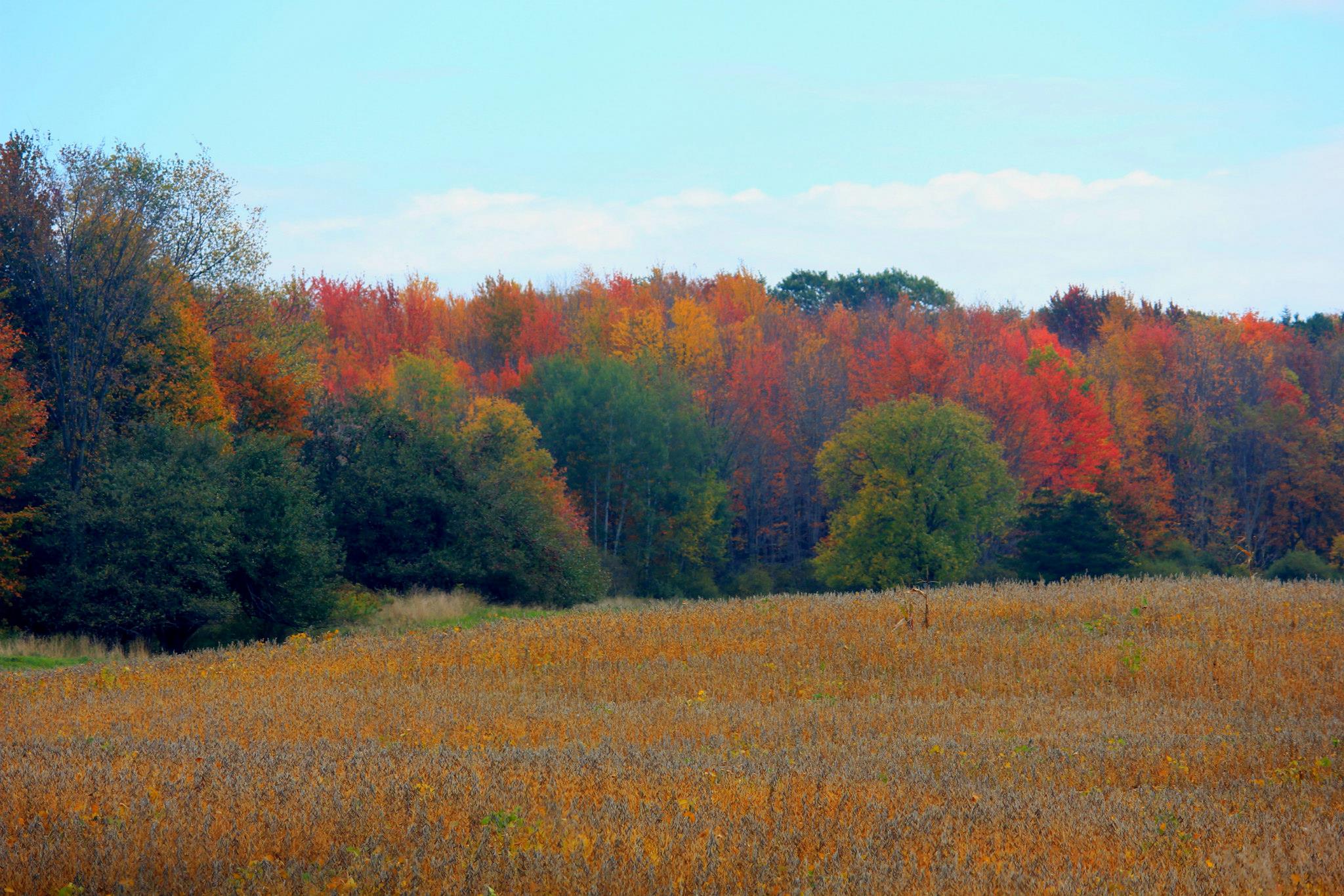
Altmar, NY foliage
Altmar, NY foliage
Stud Washington Steelhead
Nice Bow
Nice Bow
Early morning steelie on the Oswego river

Oneida Lake Fall Walleye Blitz

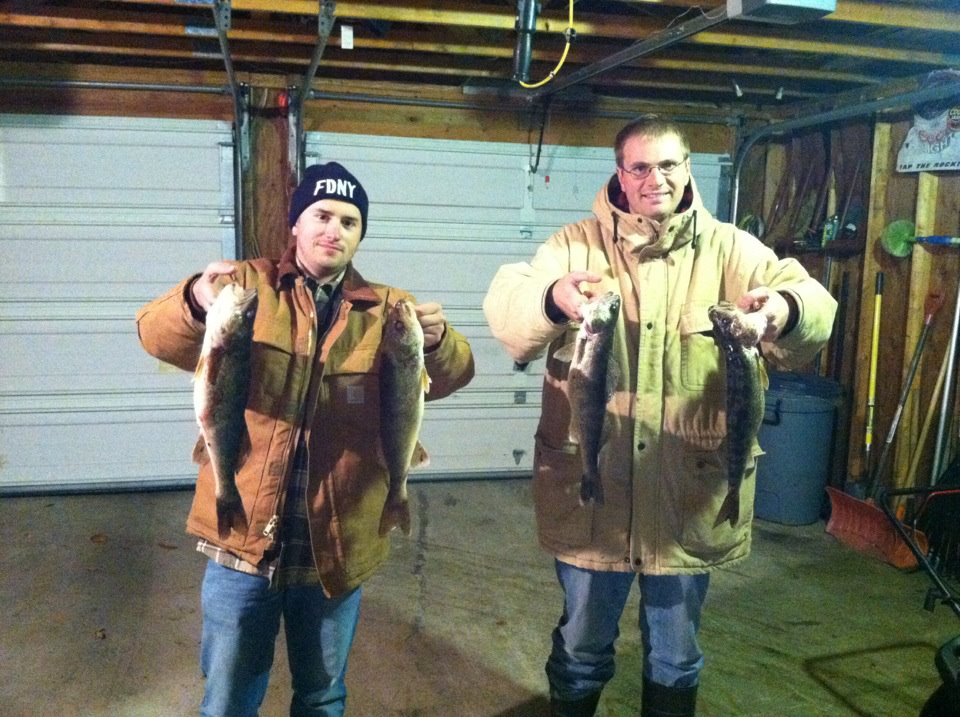
My Cuse buddies with a nice set of Fat eyes

I moved out of Syracuse, NY a little over three years ago and one of the things I miss most (other than dirt cheap rent) is the Fall Walleye Fishing on Oneida Lake. Walleye fishing becomes one of the hottest attractions of the fall, fish start becoming aggressive in their feeding routines, chasing bait into the shallower waters and circling the lake with a nightly feeding “schedule.”

What sets this time of year apart from the springtime walleye fishing, is the lure selection. In the spring we strictly utilized a 3/8” oz jig dipped with a juicy nightcrawler tail, jigging it on the bottom around 15 feet. As the temperature increases, the fish would head towards deeper waters, thus requiring a heavier jig. With fall the water temperature dropping,  large schools of walleye gravitate back towards the shallows, consistently circling the lake for balls of baitfish. With the fish coming shallower and following a more aggressive feeding pattern, stick baits would be our main lure choice. We’ve had great success with the Rapala X-Rap. This lure is a “slash” bait that suspends in the water and produces a radical motion. The reason I love this bait so much is that it is designed for the shallower water and the color patterns offered are extremely realistic. The X-Rap gives you that edge in weed “evadement” and also allows you to cast a significant distance with its long cast technology.  In my opinion, this is hands down the top bait to use in the fall. Just cast it out there and hook up.

Rapala X-Rap
Rapala X-Rap

The best time to fish in the fall is dependent on a few environmental factors:

  • Water temperature: colder temperatures allow fish to swim into the shallows feeding  on baitfish.
  • Wind direction and speed: generally you want to fish into the wind or in a cove where the wind is pushing waves to shore. This will push the bait closer and in turn schools of walleye will aggressively follow.
  • Time of day: preferably in the evening within an hour of sunset. You can start fishing in October and end Mid-November, just keep in mind, the activity is dependent on the water temperature as mentioned above
Hot Color Patterns
  • Silver and Black
  • Clown
  • Perch
  • Fire Shad and Standard Shad

Thanks for reading and if you have any questions, please do not hesitate to contact me at greenlakechronicles@gmail.com. Be sure to check out our Facebook and Instagram pages for good pictures and videos!

Michael