

It has been an exciting past few weeks for the Green Lake Chronicles crew and I am happy to share this first hand story about an awesome hunt Walter experienced in mid-September. Walter is a hunting veteran from Catskills, NY, who has harvested many great animals in his day, but this was going to be his first adventure chasing elk with a bow. Enjoy!
“My first elk hunt was going to be an archery season trip to the Bitterroot Mountains of Montana. Our son, Max, had taken a teaching job in Darby four years earlier and had spent many hours afield learning the ways of Wapiti , the Indian name for elk.
Recently retired, my wife, Jeanne, and I loaded up the truck camper and headed for Big Sky country. Mid-September, prime time for the elk rut, was our target date to be in the mountains. We set up camp in a valley meadow by a small trout stream several miles back in on a National Forest Service dirt road. I spent the first few days hiking ridges looking for elk sign and acclimating to the higher elevation. A freshly-used wallow presented itself on one such hike. “This would be a good place to sit,” I told myself, based on the warm, sunny days we were experiencing. I sat two mornings there in my blind and saw nothing. It was now day five and I was starting to feel a little discouraged with locating elk in the vast wilderness, though I had read that elk are where you find them.
“Tomorrow will be an adventure, no matter what,” Jeanne said, reminding me that Max would be my hunting guide for the weekend. I had mixed feelings on that. Max knew of some great spots and could “talk” elk, but his reputation for death-march hiking scared me. I slept fitfully that night, reviewing my gear and rehearsing the perfect shot in my mind.
 “Dad, wake up. It’s time to go!” came a voice from the door of the Bear Den, a guest room Max had recently built. It was a clear, frosty, full-moon morning as we drove up into the mountain pass. “We’ll be hiking up this drainage today,” he said, pointing to a trailhead as he parked at the end of the gravel road. We worked our way up the trail in the darkness with the moonlight providing enough illumination to see the rocks and blowdowns in our path. A cool, balsam scented breeze down drafted from the Continental Divide above.
After almost an hour, we veered off toward the first in a series of north facing alpine meadows. All of a sudden, I felt this supernatural sense of consciousness come over me: the smells in the air stronger, the colors brighter, and a feeling of calm and heightened awareness. “Something is going to happen today. Something good, ” I thought. I have had this feeling of the presence of God in the deer woods before and knew not to dismiss it.
Max stopped, took off his pack and said it was time for us to ready our bows As I removed my pack, he hushed me: “Listen!” A cow’s mew, then another, broke the silence from the lodgepole timber above the first meadow. We scrambled to put on our releases, nock arrows, and get the calls ready. He instructed me to take a stand between him and the elk while he called to them from behind. I quietly moved up to the bottom edge of the meadow and concealed myself in the trees.
Max started cow calling and then I heard the clashing antlers of sparring bull elk. Max kept up the cow calling but, after hearing the real cows drifting away, resorted to bugling. That did the trick! I saw a bull appear in the distance at the top of the steep meadow. Another blow on the bugle call brought two bulls trotting down toward me. “This is it,” I said to myself, still calm from the feeling that came over me just a short while before.
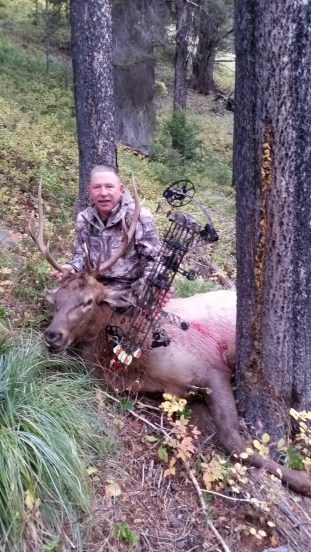
As the first bull disappeared behind some shrubs, I drew my bow and estimated the yardage. He reappeared, still moving toward Max, and I followed him with my 20-yard pin. Just as I found the spot behind and below the shoulder, he stopped. I touched off the release. The arrow flew true and buried to the fletching in his chest. The bull ran off into the timber 50 yards away and fell.
I ran down to Max who was running to me and met with an emotional embrace.
Max expertly dressed, skinned, and quartered the 5 x 5 bull, readying the excellent meat for the two backpack trips back to the truck. By noon we were back on the road to Darby where the elk quarters would hang for five days in Max’s cooler and be butchered into fine fare for the table.
I am a blessed man!”

Thank you for the great story Walt. I welcome others to share stories of exciting memories afield. Email me at greenlakechronicles@gmail.com with your story along with a few pictures and you could be the next Viewers Choice Post! Thank you for reading. Be sure to check out our Facebook and Instagram pages for more great pictures!
-Michael



 Green Lake Chronicles